Reflections on Five Years of the Stop the Grind Initiative
Lessons from five years of campaigning to end the grindadráp in the Faroe Islands, by Stephanie Lvovich, Founder and Managing Director of Shared Planet
Five years ago, Shared Planet and Sea Shepherd partnered on the Stop the Grind initiative, a campaign dedicated to ending the “grindadráp” hunt of pilot whales and dolphins in the Faroe Islands. This moment offers an opportunity to reflect on our collective achievements, in addition to the challenges and lessons learned throughout this journey that has been so impactful for me and for Shared Planet.
In our five years of working together, Shared Planet and Sea Shepherd have successfully translated a complex environmental and animal-protection issue into a coordinated programme of research, stakeholder engagement, communications and policy advocacy focused on challenging the hunt. The initiative shows the value of combining frontline evidence with strategic coalition-building and international influence: bringing together actors who might not otherwise work together, creating channels between civil society and political decision-makers, and sustaining attention on an issue over several years.
The contribution I am most proud of is supporting Sea Shepherd as it expanded and evolved its advocacy approach on this campaign — supporting its ambition to adopt a more collaborative and proactive approach to engagement with stakeholders on concrete opportunities for policy change, rather than relying on a naming-and-shaming approach that had formed the foundations of the campaign decades ago. Today, the Stop the Grind initiative collaborates with a wide range of international policymakers, diplomats and scientific experts, applying pressure from both inside and outside the Faroe Islands to encourage the government to rethink the Grind hunts.
Key Achievements from the Last Five Years
Hosted a discussion in the European Parliament in 2025, and subsequent political engagement that followed.
Supported the tabling of an Early Day Motion in the UK Parliament that was supported by 72 MPs from six parties.
Contributed to the successful campaign to gather 100,000 citizen signatures in the UK to challenge the continuation of free trade with the Faroe Islands, which was subsequently discussed in Parliament.
Hosted the launch of our Evidence Report on the Grind hunt in the UK Parliament in 2026.
Increased engagement with Faroese residents, with the quality and quantity of engagement increasing each year.
Developed stronger legal and policy arguments that cut across a range of topics and facets of the challenges relating to the Grind hunt.
Broadened political support across party lines at both UK and European levels.
Where We Began
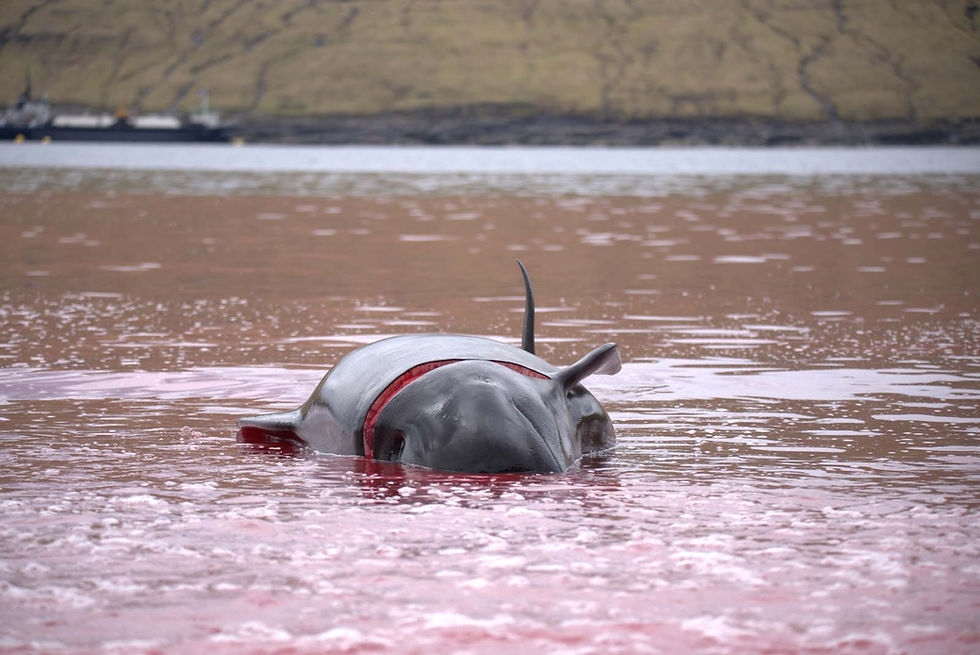
Shared Planet first engaged with Sea Shepherd on the Faroe Islands whaling issue following the 12 September 2021 grindadráp, in which hunters killed 1,428 white-sided dolphins. This was one of the largest organised killings of dolphins on record. Media coverage of this long-standing practice sparked widespread public outrage, with the Sea Shepherd team playing a central role in documenting the gruesome events on Faroese shores.
Sea Shepherd’s four decades of campaigning had already brought the Grind to global attention. However, while public condemnation was growing, there was no platform for the many concerned parties to work together. After so many years, the issue had also come to be seen as primarily Sea Shepherd’s cause, which limited the perceived ‘permission’ of others to engage and partner with Sea Shepherd. The Stop the Grind Initiative was created to build a broader, more inclusive platform. As advocacy has evolved over the decades, with a growing emphasis on coalition-building, the partnership with Shared Planet offered an opportunity to diversify tactics and expand the support base. Together, the ambition has been to widen the circle of voices engaging with the issue, including European governments, policymakers and other NGOs, so that the Faroese government hears concern from a far broader range of stakeholders and is encouraged to rethink the Grind hunts.
Challenges of the Campaign
For me personally, Stop the Grind has been a particularly challenging campaign, despite my thirty years of global advocacy experience. It is rare to work on an issue with a 40-year history of advocacy behind it. The challenges that have prolonged the need for this campaign are multifaceted, reflecting both the legal framework within which the Grind sits and the way Sea Shepherd’s advocacy approaches have evolved over four decades.
A lack of legal clarity and certainty: Success in an international advocacy campaign depends on understanding the legal guardrails within which it operates. For many years, those guardrails were unclear, which limited the range of advocacy pathways the Stop the Grind team could pursue with confidence. The legal position is intricate; the Faroe Islands have a distinct legal and political relationship with Denmark, and Denmark’s own relationships with the EU and with international bodies and treaties (e.g. the International Whaling Commission and CITES) shape how law applies to the Faroe Islands. In practice, derogations have limited the extent to which the Faroese government can be held to commitments that would otherwise apply under existing treaties and frameworks. Over the last five years of stakeholder engagement, European and international government officials have often wanted to take a stand, but a sense of “legal helplessness” has allowed them to disengage once they learn of these derogations. We did not fully understand this complexity when the campaign began, and for years we worked amid uncertainty about what we could and should do, until we commissioned a legal analysis. It anchored Stop the Grind’s work in a clearer picture of the legal pathways and geographies that could best serve the campaign, marking a critical turning point for us.
The need to diversify campaign operationalisation and targeting: Sea Shepherd is an outstanding campaigning organisation with a very specific way of working, having typically focused its engagement and communications with the general public through social media and digital storytelling to lead and fund its campaigns. Shared Planet has helped to foster a different approach, building on that history of visual storytelling with research, analysis and policy briefings to target stakeholders that can drive policy change in the Faroe Islands. Communications with key stakeholders, particularly those in government, require a different set of tools from the campaigning toolbox: the interrogation of academic literature to distill findings into written reports and briefs that build holistic understanding of the topic and can be used and re-used across different fora. Stakeholder meetings, roundtables and issue discussions have also been key to engaging a broader set of stakeholders. Sea Shepherd has embraced this evolution, casting a wide net and seeing what opportunities result. The campaign has benefitted from this significantly, fueling progress and enabling stakeholder buy-in.
Building stronger lines of argument: Whilst Sea Shepherd’s track record of work on the Faroe Islands campaign developed its familiarity with several argumentation pathways, many had not yet been thoroughly explored from a traditional advocacy perspective. Shared Planet identified this as a gap early on, and provided the necessary guidance to implement a more traditional approach to public affairs — one that suited wider stakeholder and government audiences and focused on policy analysis and scientific data as the default platform for discussion of the issue. We dedicated a significant amount of time to researching and exploring these different advocacy approaches, looking beyond the hunt’s obvious cruelty and excessive violence to examine how the consumption of whale and dolphin meat affects the community’s mental well-being, its health and the prevalence of non-communicable disease, in addition to other angles. Working with academics, NGOs, experts and others to uncover a wider set of arguments that challenge the validity of the grindadráp from a variety of different angles is a priority we continue to explore.
These challenges were meaningful in shaping our strategy; unlike other, more straightforward advocacy campaigns, it took time for us to identify the strongest lines of argument and formats through trial and error. Overcoming these challenges together as a team over the years is what makes working on this campaign so rewarding. Much of Shared Planet’s partnership with Sea Shepherd has been about joint discovery and the painstaking pursuit of small victories despite all of the challenges we face. We are moving in the right direction and starting to truly see the benefits of our collaboration.
Five Lessons from Five Years
Lesson 1: A ‘pincer’ movement of multi-faceted arguments is necessary; animal cruelty and suffering isn’t enough.
Sea Shepherd’s efforts to end the Grind had long focused on the distinct cruelty of each hunt, leading the campaign’s engagement to peak during and immediately after a Grind event. This created a perverse dynamic in which the Grind itself was necessary to capture the world’s attention.
It also became clear that animal cruelty alone does not generate enough pressure on the Faroese government. If it did, the Grind would have ended long ago. Arguments have proved more persuasive when they take a broader view that includes human implications, such as food safety and public health, and the complexity of tradition and consumption. So, we shifted our focus to the events and dynamics that lead up to a hunt, and to building engagement that doesn’t depend on the hunt itself. A single Grind is not the story.
That shift is paying off; it is no coincidence that this year we have had some of our highest levels of engagement with policymakers in the UK, Europe and beyond, even though, at the time of writing, there has been no Grind since May, meaning no hunts across most of the typical May to October season.
Our arguments have also broadened beyond the moral case against animal cruelty to speak the language of key influencers. We now also challenge the legal, trade and policy frameworks that allow the Grind to continue. Our targets also go beyond the Faroe Islands to EU decision-makers who publicly denounce the hunt while continuing to extend free trade agreements, research and cultural exchanges, and legal loopholes that benefit the Faroe Islands. In 2025, for example, Stop the Grind convened a discussion at the European Parliament on the evidence and potential EU policy solutions relating to the Faroese pilot whale hunt. This year, we brought these strands together in a single report, launched at the UK Parliament, covering public health, biodiversity conservation, trade and animal cruelty. The result is a growing, better-informed group of political allies who can challenge the Grind in diplomatic discussions.
Lesson 2: A campaign to change behaviour in the Faroe Islands depends on the Faroese community supporting it.
One of the questions stakeholders ask us most often is how Faroese people themselves feel about the Grind. Who takes part, and how representative are they of the wider population? The answers matter because the Grind will not end unless the Faroese community joins the effort to stop it. Even top-down measures, such as changes in the law, can prove ineffective in ending long-standing traditional practices.
Opposition to the grindadráp from within the Faroese community can grow only if there is trust that our initiative will not vilify the entire community, and that it will show nuance and support those who choose to speak out.
Sea Shepherd’s documentation suggests that only a small proportion of the population takes part in the hunts themselves, and recent studies indicate that consumption is declining. The harder question is how an individual Faroese person moves from not participating, or holding private concerns, to publicly voicing opposition to a practice rooted in their own community.
When we developed our Stop the Grind theory of change, one central pillar was reshaping the public conversation in the Faroe Islands. This brought early stumbling blocks, including the language barrier and little response to our initial outreach through digital platforms.
This year, the on-the-ground team has made important inroads, thanks to the visibility of Valentina Crast, our Stop the Grind Campaign Lead, and the Sea Shepherd crew and their more targeted focus on information gathering. A key lesson has been to let people engage at their own pace and through their own channels. Speaking openly about the Grind can have real social consequences, and it takes courage to go first. So we have worked to listen, build trust, and support Faroese people who want change to take the lead themselves. More local people are now approaching the crew directly. Over the next five years, Stop the Grind hopes to expand this work and provide the tools and materials that give Faroese people the confidence to speak openly against the Grind.
Lesson 3: Every activity needs to be connected to a viable pathway to end the Grind.
Taking new angles and staying flexible enough to explore new leads and avenues has been one of the campaign’s key successes. But as with any campaign, we learned that we can’t do everything at once, and that all campaign activities ultimately need to connect to the Faroese people or their government deciding to end the grindadráp. Creating a theory of change has grounded our work in defined outcomes and given us a clearer overall picture of what we are trying to achieve at the local, national and multinational levels. It has also allowed us to stress-test and sense-check whether new proposed activities would contribute to our goal. This has helped us to develop a clear belief system and take advantage of opportunities as they come along. Our ambition stays the same, and our actions and messaging adapt as the environment evolves.
Lesson 4: Tailor the message to the audience.
We have found that this issue can cross traditional political divides, provided our political engagement is targeted and resonates with the individual decision-maker's interests. In the UK, our initiative advanced an Early Day Motion (EDM) tabled in Parliament, which condemned the grindadráp and called for the issue to be addressed in future trade discussions. It was also supported by 72 MPs from six parties: Labour, the Liberal Democrats, the Green Party, the SNP, Plaid Cymru and the DUP. The event we hosted in the UK Parliament also drew broad support, including many Conservative MPs.
We have been successful in generating this multi-party support by identifying the issue’s relevance to the individual MPs. With Scottish MPs, for example, we drew on their close connection through geographic proximity to the Faroe Islands and the fishing trade between them, making the issue feel close to home. Similarly, for the Green Party, we linked grindadráp closely to sustainability and biodiversity conservation. The approach to the European Parliament is the same: a 2025 motion for a resolution won support from across the political spectrum — from The Left, S&D and the Greens to groups on the right and non-attached members. The lesson is that the Grind cuts across party lines because it can speak to both progressive and conservative values.
Lesson 5: Evolving the team and talents contributing to the effort is critical.
In a campaign, it is easy to default to the same core team driving activities. However, we have seen that our Stop the Grind campaign has truly evolved most when new voices and talent come into the mix. The capabilities of the core team must evolve to match and address the campaign priorities and focus as the external environment changes. Adding new Sea Shepherd team members, external agency partners (Higginson), and changes within the Shared Planet team itself have strengthened our insights and ability to act at each stage over the last five years. This has made our external campaigning activity stronger.
Final Reflections
Sea Shepherd has been a very meaningful and important part of Shared Planet’s seven-year history. Our partnership and commitment to each other is an extraordinary testament to our shared passion, the cultural fit between our two organisations, and the strong respect we have for each other’s contributions. I am truly grateful for this partnership and the trust the Sea Shepherd has placed in us.
Together, we have worked tirelessly to explore new avenues of advocacy, building sustained international pressure through multiple channels to achieve breakthroughs, rather than relying on a single campaigning approach. But there is so much more to do, and I am convinced that the best is yet to come. We are closing in on a realistic possibility that the grindadráp will indeed stop.


Comments