New Report Challenges Claims That Faroese Whale Hunts Are Driven by Subsistence Needs
Stop the Grind has launched a landmark new report challenging two of the central arguments used to defend the killing of pilot whales and dolphins in the Faroe Islands: that the hunts meet a genuine subsistence need and that the number of animals killed is sustainable.

The Case Against the Grind: Inhumane. Unsustainable. Unfit for Human Consumption brings together research and analysis examining the Grind through the lenses of animal welfare, sustainability, public health, cultural demand and international trade.
The findings reveal a growing disconnect between the number of pilot whales being killed and the amount of whale meat actually consumed in the Faroe Islands.
Far More Whales Are Killed Than Needed for Consumption
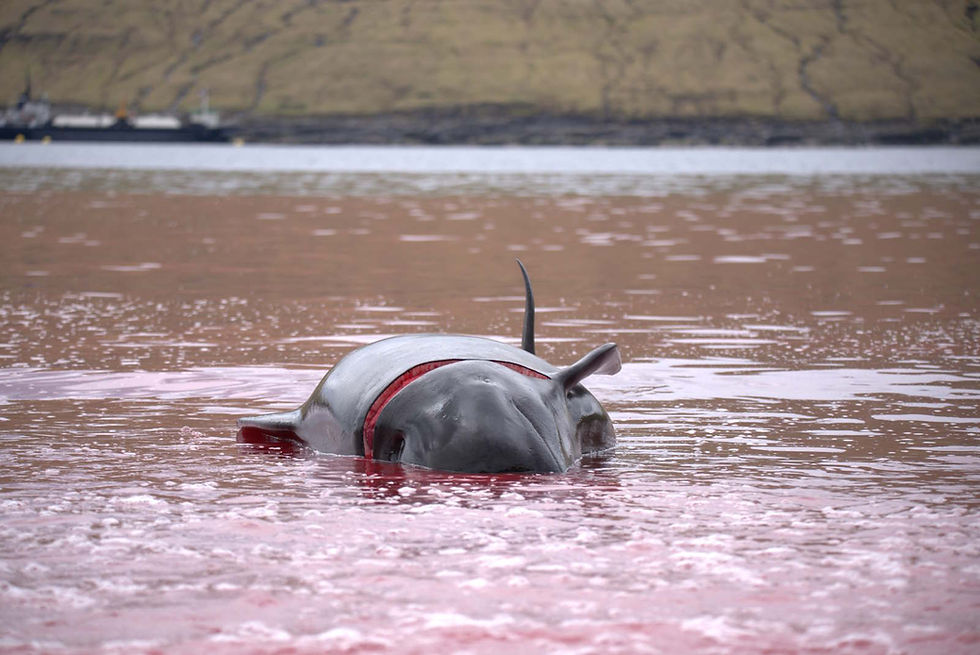
Consumption of pilot whale meat in the Faroe Islands has fallen dramatically over the past four decades, from an estimated 4.4 kg per person per year in 1982 to around 1 kg in 2024. Yet the number of whales killed has not declined at anything approaching the same rate.
Based on current consumption estimates and the size of the Faroese population, the report calculates that approximately 55 pilot whales per year would be sufficient to meet current levels of local consumption.
By comparison, an average of 827 pilot whales were killed each year between 2020 and 2025. The report estimates that this produced an average annual surplus of more than 634,000 kg of pilot whale meat beyond what would be required at current consumption levels.
These calculations do not include Atlantic white-sided dolphins. A further 1,491 white-sided dolphins were killed between 2020 and 2025, despite the report finding no demonstrated subsistence need for their meat.
The findings raise serious questions about whether the current scale of the Grind can credibly be justified by local demand or subsistence needs.
The True Number of Animals Killed Is Even Higher
Even the official figures do not capture the full scale of the killing. Official Grind statistics count animals taken for consumption, but exclude fetuses of pregnant whales, small juveniles and other discarded animals. This means the true number of animals lost during the hunts can be significantly higher than the headline figures suggest.
This also has implications for claims that the hunts are sustainable. The report highlights uncertainties surrounding the population structure of long-finned pilot whales and the potential consequences of hunts that can remove entire family groups. Broad estimates of abundance may not capture the impact on individual populations, matrilines or genetic diversity.
Whales and Dolphins Lose Legal Protections
The report also highlights a significant change to Faroese law in 2026: amendments adopted on 28 May 2026 removed marine mammals killed in the Grind from the scope of the Faroese Animal Welfare law. Pilot whales and other dolphins targeted during the hunts are therefore no longer covered by the same general animal welfare principles that apply to other animals.
Although separate Grind legislation regulates how the hunts are organised, the report finds that it contains no equivalent substantive animal welfare protections.
With consumption declining, substantial quantities of meat exceeding estimated local demand, and hunted whales and dolphins now afforded fewer legal protections, it is increasingly difficult to see how the Faroese Government can defend the current scale of the Grind on cultural, subsistence or sustainability grounds.
The UK Has an Opportunity to Act
The findings are particularly relevant to the United Kingdom because of its trade relationship with the Faroe Islands. The report argues that access to valuable markets can provide governments with meaningful leverage to improve marine mammal protections. It points to the United States as an example of market access being linked to marine conservation requirements and examines how similar principles could inform UK and EU policy towards the Faroe Islands.
Stop the Grind is calling on the UK Government to consider using its trade relationship with the Faroe Islands to encourage stronger protections for pilot whales and dolphins and to help bring an end to the Grind.
The report also calls for greater alignment between the marine conservation standards the UK and EU uphold domestically and the standards reflected in their external trade relationships.



Comments